Mostrando entradas con la etiqueta gramática. Mostrar todas las entradas

jueves, 23 de julio de 2009

El autor y su obra, solución.

Mark Twain 1900The Prince and the Pauper
Mark Twain (1835-1910) - "El príncipe y el mendigo" (1881)

PISTA 1 – Su primer seudónimo era: Thomas Jefferson Snodgrass.
(Clue 1 – His first pen name was: Thomas Jefferson Snodgrass.)

Samuel Langhorne Clemens (1835-1910) adoptó varios seudónimos antes de decidirse por el definitivo Mark Twain (el día 3 de Febrero de 1863 por primera vez utiliza su famoso seudónimo, Mark Twain, firmando una columna humorística, "Carta desde Carson City".

Otros seudónimos fueron: Quentin Curtius Snodgrass, Thomas Jefferson Snodgrass, Josh en sus artículos hasta 1863 y Sieur Louis de Conte en la novela "Recuerdos personales de Juana de Arco" (1896)

(Samuel Langhorne Clemens took several pen names before the final Mark Twain (on February 3, 1863 he first used his famous pen name, Mark Twain, signing a humorous travel account "Letter from Carson City").
Other pseudonyms he used: Quentin Curtius Snodgrass, Thomas Jefferson Snodgrass, Josh for his articles and travel letters until 1863, Sieur Louis de Conte in "
Personal Recollections of Joan of Arc".)

Mark Twain and Halley's cometPISTA 2 – Tanto su nacimiento como su muerte fueron marcados por la aparición del cometa Halley.
(Clue 2 – Both his birth and death were marked by the appearance of Halley's Comet.)

De hecho se cuenta que él mismo dijo en 1909:
“Nací con el cometa Halley en 1835. Vuelve el año que viene y espero irme con él. Sería para mí la mayor desilusión de mi vida si no ocurriera así. Estoy seguro de que el Todopoderoso ha pensando: 'Estos dos fenómenos que han llegado juntos, que se vayan juntos.'"

Twain falleció de un ataque al corazón el 21 de abril de 1910 en Redding, Connecticut, un día después de que el cometa alcanzara el punto más cercano a la tierra el 20 de abril.

(In 1909, Twain is quoted as saying:
“I came in with Halley's Comet in 1835. It is coming again next year, and I expect to go out with it. It will be the greatest disappointment of my life if I don't go out with Halley's Comet. The Almighty has said, no doubt: 'Now here are these two unaccountable freaks; they came in together, they must go out together.'”
In fact, Twain died of a heart attack on April 21, 1910 in Redding, Connecticut, one day after the comet's closest approach to Earth on April 20.)

Stormfield 1908-1910Dorothy Sturgis's angelfish brooch

PISTA 3 – A su vejez dirigió "El club del acuario" y regalaba a sus miembros broches en forma de pez ángel.
(Clue 3 – In his old age he led the "Aquarium Club" and presented members with angel-fish pins.)

En 1906, Twain decía: "Había llegado a la fase de abuelo en la vida sin nietos por lo que empecé a adoptarlos" para explicar la razón por la que formó un club de chicas, los Peces ángel y el Club del Acuario cuya insignia era un alfiler de esmalte verde azulado con forma de pez ángel. La docena aproximada de miembros tenían edades comprendidas entre 10 y 16 años y Twain recibía, y les escribía, cartas y las invitaba con sus madres a conciertos y al teatro, y a juegos en Stormfield.

(In 1906, Twain said: "I had reached the grandfather stage of life without grandchildren so I began to adopt some." to explain why he formed a club of girls, the Angel Fish and Aquarium Club whose devise was a glittering blue-green enamel angelfish pin. The dozen or so members ranged in age from 10 to 16. Twain received and wrote letters to them, and invited them with their mothers to concerts and theatre, and to play games at Stormfield.)

También mantenía otro club, el Club Juggernaut ["Juggernaut" es uno de los nombres del dios Krishná, encarnación terrestre de Vishnú] formado por mujeres. Twain explicaba que "Son todas amigas que no he visto nunca (excepto una), pero que me han escrito cartas cordiales. Según las leyes de mi club sólo puede haber un miembro por país."

(He also maintained another club, the Juggernaut Club, ["Juggernaut" is one of the many names of Krishna, an avatar of Vishnu], which comprised older women with whom he corresponded. He said: "They are all friends whom I have never seen (save one), but who have written friendly letters to me. By the laws of my club there can be only one member in each country.)
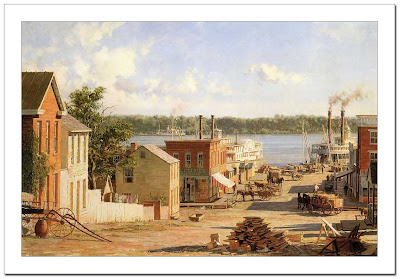
Hannibal, a view from Twain's boyhood home in 1841 by John StobartHannibal, a view from Twain's boyhood home in 1841 by John Stobart.

PISTA 4 – Durante dos años viajó por un río cuya cuenca es tan grande como la superficie de Inglaterra, Gales, Escocia, Irlanda, Francia, España, Portugal, Alemania, Austria, Italia y Turquía.
(Clue 4 – For two years he travelled along a river whose area of its drainage-basin is as great as the combined areas of England, Wales, Scotland, Ireland, France, Spain, Portugal, Germany, Austria, Italy, and Turkey.)

Río Misisipi: Longitud 3.770 km — Superficie de la cuenca:3.238.000 km²
(Mississipi River:length:2,320 miles — Area of the basin: more than 1,245,000 sq mi)

CountryEnglandWalesScotlandIrelandFranceSpainPortugalGermanyAustriaItalyTurkey
km² 130,39520,77978,78284,412675,417504,64592,391357,05083,871301,338780,580
Total: 3,109,660 km²

Capt. Isaiah Sellers Twain's signatures
Captain Isaiah Sellers (1802-1864) tombstone at Bellefontaine Cemetery, Saint Louis, Missouri.

PISTA 5 – Uno de sus personajes más famosos está basado en Tom Blankenship, un amigo de la infancia
(Clue 5 – One of the most famous characters is based on Tom Blankenship, a childhood friend.)

Ya habréis adivinado que se trata del personaje de Tom Sawyer —Las aventuras de Tom Sawyer (1876). Twain era dado a ello y lo más curioso es cómo y por qué eligio su propio seudónimo.
Como ya sabemos "Mark Twain" significa "Marca dos (brazas)" un expresión utilizada en el Misisipi para indicar la profundidad . La "Marca dos" era el calado mínimo seguro para la buena navegación.

Otra versión cuenta que el seudónimo viene de su época "salvaje" en el Oeste, cuando solía llevarse un par de bebidas y decirle al dueño que "apuntara dos" en su cuenta.

(You must have guessed we are talking of Tom Sawyer —The Aventures of Tom Sawyer. Twain used to do so and most curious was the way and why he chose his own pseudonym.
As we already know "Mark Twain" means "two fathoms deep" a slang expression on the Mississippi River. "Mark Twain" was the minimum depth of water to safe navigation.
Another story says that the name comes from his "wild "days in the West, when he would stop in at a saloon, buy two drinks, and tell the bartender to “mark twain” on his tab.)


Y el propio Twain nos explica:

Life on the Mississippi (1883) by Mark Twain
Chapter 50 - The 'Original Jacobs'

We had some talk about Captain Isaiah Sellers, now many years dead.(...)
The old gentleman was not of literary turn or capacity, but he used to jot down brief paragraphs of plain practical information about the river, and sign them 'MARK TWAIN,' and give them to the 'New Orleans Picayune.' They related to the stage and condition of the river, and were accurate and valuable; and thus far, they contained no poison. (...)
One of these articles became the text for my first newspaper article. I burlesqued it broadly, very broadly, stringing my fantastics out to the extent of eight hundred or a thousand words. I was a 'cub' at the time. I showed my performance to some pilots, and they eagerly rushed it into print in the 'New Orleans True Delta.' It was a great pity; for it did nobody any worthy service, and it sent a pang deep into a good man's heart. There was no malice in my rubbish; but it laughed at the captain. It laughed at a man to whom such a thing was new and strange and dreadful. I did not know then, though I do now, that there is no suffering comparable with that which a private person feels when he is for the first time pilloried in print.
Captain Sellers did me the honor to profoundly detest me from that day forth. When I say he did me the honor, I am not using empty words. It was a very real honor to be in the thoughts of so great a man as Captain Sellers, and I had wit enough to appreciate it and be proud of it. It was distinction to be loved by such a man; but it was a much greater distinction to be hated by him, because he loved scores of people; but he didn't sit up nights to hate anybody but me.
He never printed another paragraph while he lived, and he never again signed 'Mark Twain' to anything. At the time that the telegraph brought the news of his death, I was on the Pacific coast. I was a fresh new journalist, and needed a nom de guerre; so I confiscated the ancient mariner's discarded one, and have done my best to make it remain what it was in his hands-- a sign and symbol and warrant that whatever is found in its company may be gambled on as being the petrified truth; how I have succeeded, it would not be modest in me to say.

A pesar de ser considerado un escritor humorístico, como dijo un crítico, sobre todo en los últimos años de su vida, "a Twain no le gustaban demasiado los seres humanos, excepto como diana de su menosprecio, indignación o cólera... Envió su enérgica prosa a crepitar sobre las cabezas de (entre otros) funcionarios arrogantes, músicos y cantantes ineptos, mujeres vanidosas, conferenciantes que fingían haber conocido a Dickens, pesados, hombres que violentaban a las mujeres, inteligentes conversadores de "dos años", redactores, linchadores, científicos que deducían demasiado de demasiados pocos indicios, timadores (a menos que tuvieran clase) y, en defensa del "honor de la familia", de todos los seductores de mujeres."

(In spite of being regarded as a humorous writer, as a critic pointed,above all in his last years, "Twain didn't like human beings much, except as targets for his scorn, indignation or wrath.... He sent his energetic prose crackling about the heads of (among others) arrogant public officials, inept musicians and singers, vain women, lecturers who pretended to have known Dickens, noisemakers, males who did violence to females, smart-talking two-year-olds, editors, lynchers, scientists who deduced too much from too little evidence, swindlers (unless they had style), and, in a ferocious defense of `family honor,' all seducers of women.")

Mark Twain es considerado una de las más grandes figuras de la literatura norteamericana. William Faulkner lo llamaba el "primer escritor verdaderamente americano" y Ernest Hemingway llegó a decir: "Toda la literatura norteamericana moderna procede de un libro de Mark Twain titulado Huckleberry Finn... No existía nada antes. No ha habido nada tan bueno desde entonces."

(Twain is widely held to be one of the great figures in American literature. Faulkner called him “the first truly American writer.”, and Ernest Hemingway once said, “All modern American literature comes from one book by Mark Twain called Huckleberry Finn…There was nothing before. There has been nothing as good since.”)

Por lo que a mí respecta no soy tan categórico, pero es un escritor que no deja de sorprendernos cada vez que lo leemos y muy moderno en sus opiniones.
Si os acercáis por algunas de estas direcciones, juzgaréis por vosotros mismos:

thumbtackLibros de Mark Twain en la Biblioteca Cervantes virtual.

thumbtack151 artículos y libros de Mark Twain en la Biblioteca Dominio público que incluso te puedes bajar en PDF

thumbtackEn Project Gutenberg también están los libros de Twain que te puedes descargar (en inglés la mayor parte) y también en audio-libro en MP3 (ideal para practicar si quieres).

thumbtackPage By Page Books para leer libros (en inglés), entre ellos de Mark Twain.

thumbtackDescargar algunos Clásicos Ilustrados en español.

thumbtackTambién puedes visitar la casa de infancia de Mark Twain en Hannibal , (Missouri) convertida en museo: The Mark Twain Boyhood Home and Museum.

thumbtackO la casa en la que pasó la mayor parte de su vida en Hartford, Connecticut, The Mark Twain House and Museum e incluso podéis hacer un recorrido virtual por algunas partes de la casa.

Y os dejo con un cóctel que hoy día lleva su nombre, un Mark Twain:
Mark Twain cocktail

Ingredientes:
*Whisky escocés - 45 ml
*Zumo de limón - 25 ml
*Almibar - 30 ml
*Angostura Bitters - 2 gotas
Preparación:Agitar todos los ingredientes en coctelera con abundante hielo y colar en copa de Martini previamente refrescada.


Este cóctel fue descrito a su esposa Olivia por Twain en una carta desde Londres en enero de 1874:

" Livy my darling, I want you to be sure & remember to have, in the bathroom, when I arrive, a bottle of Scotch whisky, a lemon, some crushed sugar, & a bottle of Angostura bitters. Ever since I have been in London I have taken in a wine glass what is called a cock-tail (made with those ingredients) before breakfast, before dinner, & just before going to bed."
(Quote from "Mark and Livy: The Love Story of Mark Twain and the Woman Who Almost Tamed Him" by Resa Willis)

(Mark Twain Cocktail recipe:
* 1 1/2 ounces Scotch whisky
* 3/4 ounce fresh lemon juice
* 1 ounce simple syrup
* 2 dashes of Angostura bitters
Shake all the ingredients with ice and strain into a chilled cocktail glass.)
This drink was described by Mark Twain in a letter to his wife Olivia from London in January, 1874.)

lunes, 20 de julio de 2009

Última pista y 5

author puzzle clue 5book cover puzzle clue 5
author piece 5book cover piece 5

PISTA 5 uno de sus personajes más famosos está basado en Tom Blankenship, un amigo de la infancia

(Clue 5 – One of the most famous characters is based on Tom Blankenship, a childhood friend.)

comic strip clue 5-1I feel as though that bruise on your hand belongs on mine —› Siento como si ese cardenal en tu mano estuviera en la mía.

AS THOUGH (al igual que AS IF) + PRESENTE
para hablar de algo que nos parece REAL.

He is / was talking as if /as though he is angry.
Habla /Hablaba como si estuviera enfadado (y lo está o eso creo)

AS THOUGH / AS IF + PASADO SIMPLE
para hablar de algo IRREAL
(el verbo "be" se pondrá WERE a todas las personas)

He is /was talking as if /as though he were angry.
Habla/Hablaba como si estuviera enfadado (pero no lo está o eso creo)

OBSERVAD
que el tiempo de la oración principal NO influye en el tiempo de la subordinada.

I'm used to it —› Estoy acostumbrado (a ello)

BE USED TO + (pro)noun / verb in -ING —› estar acostumbrado a algo /hacer algo
GET USED TO + (pro)noun / verb in -ING —› acostumbrarse a algo/hacer algo

Jim is/was/has been used to living alone. —› Jim está/estaba/ha estado acostumbrado a vivir solo.
Jim is getting /was/has been used to living alone. —› Jim se está /se estaba/se ha estado acostumbrado a vivir solo.

Nothing indeed. = Nothing doing —› ¡Ni hablar! ¡De ninguna manera!

INDEED es un intensificador que recalca lo que se dice y en español se puede traducir por "desde luego (que) , por supuesto (que), claro (que)..."
— "Isn't it a beautiful day?" "Yes, indeed." —› "¿No es un día precioso?" "Sí, desde luego."
— Thank you very much indeed. —› Muchísimas gracias.
— "May I go?" "Indeed you may not!" —› "¿Puedo ir?" "¡Por supuesto / Claro que no!"

Remain here until I return —› Quédate aquí hasta que vuelva

Traducción de HASTA:
UNTIL /TILL + tiempo / oracción
TO /AS FAR AS + lugar

NO hay diferencia de significado entre UNTIL y TILL, sólo gráfica.

He won't come until/till Tuesday/3 o'clock/ you call him.
No vendrá hasta el martes/las tres/que lo llames.

He won't come to /as far as the next village with us.
No vendrá hasta el próximo pueblo con nosotros.

comic strip clue 5-2for angering him —› Por enfadarlo

FOR + (pro)noun —› PARA + sustantivo / pronombre

I bought it for him/the children. —› Lo compré para él/los niños.

FOR + amount of time /distance —› DURANTE + cantidad de tiempo /distancia
(no se suele poner al igual que en español)

He is walking (for) half an hour/(for) two miles. —› Lleva andando (durante) media hora/dos millas.

FOR + day/time —› PARA + día/hora

We need it for Monday/3 o'clock. —› Lo necesitamos para el lunes/las tres.

FOR + purpose —› POR + propósito

She runs for pleasure/for exercise . —› Ella corre por placer/por hacer ejercicio.

FOR + cause —› POR + causa

We couldn't come for the fog/missing our train. —› No pudimos ir por la niebla/perder el tren.

Pasado mañana ...la solución y el personaje.

jueves, 16 de julio de 2009

Puzzle, Pista 4

Author puzzle clue 4book cover puzzle clue 4
Author piece clue 4cover piece clue 4

PISTA 4 – Durante dos años viajó por un río cuya cuenca es tan grande como la superficie de Inglaterra, Gales, Escocia, Irlanda, Francia, España, Portugal, Alemania, Austria, Italia y Turquía.
(Clue 4 – For two years he travelled along a river whose area of its drainage-basin is as great as the combined areas of England, Wales, Scotland, Ireland, France, Spain, Portugal, Germany, Austria, Italy, and Turkey.)

comic clue4-1
commentand splatter EACH OTHER in fun —› y jugar a salpicarnos (mutuamente).

EACH OTHER + dos personas
ONE ANOTHER + tres o más

Jim and Tom quarreled; they shouted at each other.

Jim and his friends quarreled; they shouted at one another."

comic stip clue 4-2

commentso it shall be. —› ¡pues sea!

Aquí SHALL tiene valor de firme determinación. Cuando SHALL se utiliza a todas las personas (en vez de WILL) estamos dando un carácter enfático al futuro:

determinación : They shall not beat us. —› No nos ganarán.
promesa: You shall have your bike. —› Tendrás tu bici.
orden: He shall do as he is told —› Hará lo que le digan.
amenaza: I shall call the police if you don't stop. —› Llamaré a la policía si no paráis.

SHALL también debe utilizarse en primera persona del singular o del plural en preguntas para sugerir algo o para pedir intrucciones:
Shall I shut the door? —› ¿Cierro la puerta?
What shall we tell them? —› ¿Qué le decimos?

commentLet us change clothes —› Cambiémosnos la ropa.

LET + infinitivo sin "to" es un verbo ordinario que significa "dejar, permitir".
My mother let me go out till late. —› Mi madre me dejaba salir hasta tarde.

Pero LET + HIM / THEM + infinitivo sin "to" para expresar una orden o un deseo imperioso. Equivale a un subjuntivo con valor imperativo en español.
Let him go! —› ¡Que se vaya!
Let them say it! —› ¡Que lo digan!

LET + US + infinitivo sin "to" es una orden en primera persona. Se suele utilizar la contracción LET'S para no confundirse con el verbo ordinario.
Let's go to the party. —› Vamos / vayamos a la fiesta
Please, let us go to the party. —› Por favor déjanos ir a la fiesta.

La próxima entrada... la última pista, aunque seguramente ya habréis encontrado la solución. Pero lo importante es disfrutar con las tiras y si de paso recordamos algo interesante en gramática...

lunes, 13 de julio de 2009

El autor y su obra, pista 3

Author puzzle clue 3Book cover puzzle clue3
author piece clue 3book cover piece clue3

PISTA 3 – A su vejez dirigió "El club del acuario" y regalaba a sus miembros broches en forma de pez ángel.
(Clue 3 – In his old age he led the "Aquarium Club" and presented members with angel-fish pins.)

Comic strip clue 3-1
grammar

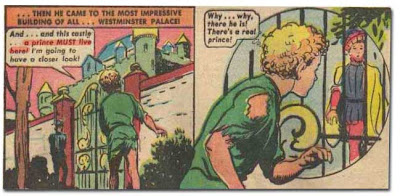
"a Prince must live here" —› un príncipe debe de vivir aquí

VERBOS MODALES DE PROBABILIDAD
a prince must live here. un príncipe debe de vivir aquí. Tom está (casi) seguro.
a prince can't live here. un príncipe no puede vivir aquí.Tom está (casi) seguro. —negación—
a prince could live here. un príncipe podría vivir aquí.Tom piensa que hay alguna posibilidad.
a prince may live here. Puede que un príncipe viva aquí.Tom especula. Cree que tiene la misma posibilidad de acertar que de equivocarse.
a prince might live here. Pudiera ser que un príncipe viviera aquí.Tom cree improbable que ocurra pero...

Comic strip clue3-2

grammar"Mind your manners!" —›¡Cuida tus modales!

grammarHow dare you treat the lad like that! —› ¿Cómo te atreves a tratar al chico de ese modo?)
• "dare" puede ser un verbo ordinario y significa "atreverse", pero también "desafiar" y va seguido de infinitivo con "to":
He dares / dared to come late.
(Se atreve / atrevió-atrevía a venir tarde.)
Does he dare / Did he dare me
to talk to him?
(¿Me desafía / desafió-desafiaba a que hable / hablara con él?)


• "dare" también puede ser un verbo modal y significa "atreverse", pero sólo se usa en oraciones interrogativas o negativas. En este caso va seguido de infinitivo sin "to"
Dare / Dared he come late?
(¿Él se atreve / atrevió-atrevía a venir tarde?)
He daren't / daren't (poco usado) didn't dare come late.
(Él no se atreve / atrevió-atrevía a venir tarde.)

• La expresión "I daresay..." = "I guess..." ="I suppose...": "Supongo..."

Comic strip clue 3-3

grammar"You look tired": look + adjective: parecer + adjetivo

grammar"You want me to come in" —› "Quieres que entre"

ESTRUTURAS CON TO WANT (QUERER)
TO WANT + objeto directo querer algo —› I want an orange
TO WANT + infinitivo con to querer hacer algo —› I want to eat an orange.
TO WANT + (pro)nombre + infinitivo con to querer que alguien haga algo —› I want Jim / her to eat an orange.


ESTRUTURAS CON TO WANT (NECESITAR)
TO WANT + objeto directo I want a haircut. (Necesito un corte de pelo.)
TO WANT + verbo en "-ING" This room wants tidying.(Esta habitación necesita ordenarse.)


Seguiremos... si os apetece.

jueves, 9 de julio de 2009

¿Quién es? ¿Qué obra es? Pista 2

Aquí va la segunda pista:

Puzzle author clue 2Puzzle book cover clue 2
Author piece clue 2Book cover piece clue 2

PISTA 2 – Tanto su nacimiento como su muerte fueron marcados por la aparición del cometa Halley.
(Clue 2 – Both his birth and death were marked by the appearance of Halley's Comet.)

Comic page 2

kindly old priest: recuerda que el orden de los adjetivos en inglés suele seguir la regla de OSiAShCOMP:


OpinionSizeAgeShapeColourOriginMaterialPurposeNOUN
akindly
old


priest
thisbeautiful

roundblack
wooden sweetsbox

"today's Latin lesson": el genitivo sajón ('s) que sólo se debe utilizar para indicar posesión o pertenencia cuando el poseedor es persona también se usa con determinadas expresiones:

1. Con nombres de instituciones, países, estados, ciudades o actividades relacionadas con el hombre.
UNO's last issue. (La última decisión de la ONU.)
Germany's economic boom. (El florecimiento económico de Alemania.)
The ballot's results. (El resultado de la votación.)

2. con expresiones idiomáticas de tiempo y, a veces, de distancia o medida:
yesterday's party (la fiesta de ayer)
two weeks' holiday (dos semanas de vacaciones)
a two miles' walk (un paseo de dos millas)
Fifty pence's worth of sweets (cincuenta peniques de caramelos)

3. Con algunos modismos:
For heaven's sake! (¡Por Dios!)
at arm's length (al alcance de la mano)

No abuses de esta forma. En CASO de DUDA utiliza la construcción con OF

"The more stories Tom heard, the more he dreamed about princes."
Cuanto más historias oía Tom, más soñaba con príncipes. (Comparación correlativa)

"Worry not" = Don't worry

"You doubt my word." (dudar de : observa que en inglés no lleva preposición)

"Tom's friends were first amused, then awed." (Los amigos de Tom estuvieron primero divertidos , después impresionados (sic): A los amigos de Tom primero les divirtió, después les impresionó.)

RECUERDA:
be + adjective ending in -ED —› ESTAR + adjetivo
be + adjective ending in -ING —› SER + adjetivo

If I could see a prince ... I'd be happy (Conditional type 2)
Si pudiera ver / viera a un príncipe... sería feliz.

What beautiful buildings!: ¡Qué edificios más/tan preciosos!
(What a beautiful building!: ¡Qué edificio más/tan precioso!)


RECUERDA:
What + a / an + adjective + singular noun!
¡Qué + sustantivo singular + más/tan + adjetivo!

What + adjective + plural noun!
¡Qué + sustantivo plural + más/tan + adjetivo!

El próximo día, más...si queréis.

martes, 7 de julio de 2009

Classics Illustrated y un juego

Classics Illustrated

Cuando hablé de ComicsWorld hace un par de semanas comenté que quería compartir unas tiras cómicas y aquí van.

En ComicsWorld encontré antiguos números de la serie Clásicos Ilustrados a la que pertenecen las páginas que voy a compartir con vosotros y he pensado en un pequeño juego: no pongo el título de la historia ni el autor pero cada dos días subiré una pieza del puzzle con alguna pista y una página de la historia a ver si reconocéis la historia y por lo tanto el autor.

(When I spoke of ComicsWorld a couple of weeks ago I commented that I wanted to share a few strips, and here they are.
At ComicsWorld I found old issues of the Classics Illustrated series to which the pages that I will share with you belong and I have thought of a little game: I will not give the title of the story nor the author, but every other day I will upload a piece of the puzzle and a page of the story with a clue so that you can guess both.)


Classiques Illustrés


Leí
esta serie cuando niño – en francés, claro – y en más de una ocasión hice caso de la recomendación que hacían al final de la revista:


Read originals"Ahora que has leído la edición de Clásicos Ilustrados, no pierdas el placer añadido de leer la versión original que puedes conseguir en la biblioteca de tu escuela o de tu barrio."

Así empezó mi afición a la lectura, a pesar de que a mis padres, eso de leer cómics, no les acababa de gustar. Espero que a alguno de vosotros también le anime a acercarse a los originales.

(I read this series as a child - in French, of course - and more than once I followed the recommendation made at the end of the magazine.
That's how my love of reading began, despite the fact that my parents didn't think much of reading comics. So I hope some of you will feel like meeting the originals.)


La serie de Clásicos Ilustrados ideada por Albert Lewis Kanter (1897-1973) empezó a publicarse precisamente con el objetivo de acercar las novelas clásicas a los jóvenes lectores en un formato de fácil acceso. Así, de 1941 a 1971 salieron unos 169 números en Estados Unidos, unos 162 en el Reino Unido, y unos 105 en España.

Hoy día tanto Papercutz en Estados Unidos como Classics Illustrated en el Reino Unido vuelven con la colección.

(The Classics Illustrated series were first published with the express aim of bringing classic stories to young readers in an easy to access format. From 1941 to 1971 169 issues were produced in the US, 162 in the UK and 105 in Spain.
Today both Papercutz in the USA and Classics Illustrated in the UK are publishing the series again. )


Empecemos el juego, si os parece:
(Let's start the game, if you please)

Puzzle authorPuzzle book cover
Piece puzzle authorPiece puzzle book cover

PISTA 1 – Su primer seudónimo era: Thomas Jefferson Snodgrass.
(Clue 1 – His first pen name was: Thomas Jefferson Snodgrass.)

Comic page 1

* slums: barrio bajo, suburbios.
(suburbs en inglés es un falso amigo, significa barrio residencial)

* There was no happiness = There was not any happiness
(no + noun = verb + not + any + noun)

* another + singular = otro, otra
(other + plural = otros, otras)

* ... to feed. (Para alimentar)
(to + infinitivo = para + infinitivo // for + noun/pronoun= para + sustantivo/pronombre

* on the very same day = ese mismísimo día

* There he is... There it is... There they are... Here he is... Here it is... Here they are...
(Allí está (él)... Allí está (algo)... Allí están... Aquí está (él)... Aquí está (algo)...Aquí están...

* spend (spent - spent) + time = pasar + tiempo
spend + money = gastar + dinero

* Tom had been made to beg: make (made - made) someone do something
Esta expresión es curiosa:
— cuando va en forma activa make + infinitivo sin "to":

She makes me laugh. (Ella me hace reír)

— cuando va en voz pasiva be made + infinitivo con "to:

He was made to laugh. (Le hicieron reír.)

Bueno, pasado mañana más... si gustáis.

 
Arriba