Mostrando entradas con la etiqueta costumbres. Mostrar todas las entradas

lunes, 3 de diciembre de 2012

Dulce España

Spoonfilm has made a series of tilt-shift* films turning beautiful locations in the world into miniature models.
Spoonfilm ha hecho una serie de películas con la técnica tilt-shift convirtiendo preciosos lugares del mundo en pequeñas maquetas.

Here is the short film Joerg Daiber has shot in Spain —in Seville, Madrid and El Chorro on Camino del Rey, Malaga, to be exact—. With the overture of The Barber of Seville by Gioacchino Rossini as music background: wonderful.

He aquí la película que Joerg Daiber ha rodado en España —en Sevilla, Madrid y en El Caminito del Rey, en El Chorro, Málaga, más concretamente—. Con el fondo musical de la obertura de El Barbero de Sevilla de Gioacchino Rossini: maravilloso.


If you feel like watching more places, here is Spoonfilm YouTube channel, Little Big World.
Si queréis ver más sitios, este es el canal de YouTube de Spoonfilm, Little Big World (Pequeño gran mundo.)

* Tilt-shift lenses allow correct the perspective so that the photograhy simulates a miniature scene.
Los objetivos descentrables o tilt shift son unas lentes que permiten corregir la perspectiva para conseguir que la fotografía parezca una maqueta.

lunes, 16 de julio de 2012

El sastre del torero

bullfigher tailor
Images from the video
I do not like bullfights because I have not managed to understand the "art" of bullfighting, although I like the vocabulary used in "Los toros", the encyclopedia of tauromachy written by José María de Cossío regarding the art of bullfighting from its origins, its history and its influence in the life and fine arts of the countries that have adopted it.

No me gustan las corridas de toro porque no he logrado entender el "arte" del toreo, aunque me gusta el vocabulario que se utiliza en "Los toros", la enciclopedia escrita por José María de Cossío sobre el arte del toreo desde sus orígenes, su historia e influencia en la vida y la cultura de los países en los que se practica.

Acording to Mario Carrión:
"Let's look at the nature of this cultural expression so innately Spanish. What is bullfighting? Is it barbarism, a sport rooted in the hunt or, an artistic expression similar to the dance? There have been many different opinions, often colored by the cultural background of the person expressing his or her thoughts. However, most Spanish people agree that it should not be considered a sport. Indeed, the translation of the Spanish term torear into the English word bullfighting, shows the prejudicial view of this event in the Anglo world. A person would have to be insane to fight a 1,200 pound beast; the objective of the bullfight is, in fact, the opposite: to avoid a brutal confrontation by using the human attributes of intelligence, grace, and elegance. In a sport, the important thing is to win; the sport fan is satisfied with the accumulation of points, hits, and records. In fullfighting, there is no scorekeeping. Satisfaction is implicit in the expected triumph of human cunning over brute force; a bullfight fun screams "olé" not because the matador has won, but because of the manner, the form, the grace, the wit, the dexterity of the torero performing a veronica, a natural, or any other pass with the capote or muleta, as the piece of cloth that he holds in his hand is called. The trophies awarded to the bullfighter are often nothing more than the people's momentary show of emotion; it is not unusual for a matador who may have only performed one artful move in the entire event to be the true winner of the day. For just as in painting, singing, or dancing, the quality that made that move special cannot be quantified or described. The appreciation of its worth is intuitive. Nevertheless, based on my reading on the subject, my practical experience as a matador, and my intuition, I define bullfighting as a type of dramatic ballet dance with death. As he would in dancing, the bullfighter must control his movements maintaining the rhythm, not of music, but of danger. On stage, a faux-pas means an interruption of artistic flow; in the bullfighting arena, a mistake could mean the death of the star of this drama."

En palabras de Mario Carrión: "Veamos ahora la naturaleza de esta expresión cultural tan netamente hispana. ¿Qué es el toreo? ¿una salvajada? ¿un deporte similar a la caza? ¿una expresión artística parecida al baile?. Ha habido opiniones para todos los gustos, pero la mayoría coinciden en no catalogarlo como un deporte. La traducción al inglés del término "toreo" como "bullfighting", que literalmente significa "pelea con toros", muestra el prejuicio extremo del concepto del toreo fuera de la hispanidad. Una persona tendría que estar loca para pelear con un monstruo de unos quinientos kilos. El objetivo del torero es precisamente lo opuesto: con gracia, elegancia, valor e inteligencia evitar el enfrentamiento. En un deporte lo importante es ganar; el aficionado a un deporte evalúa el resultado en puntos, goles o récords. En el toreo, el resultado es implícito en el triunfo esperado de la inteligencia humana sobre la fuerza bruta. Lo importante para que el aficionado grite un olé, no es que el maestro "gane" sino la manera, la forma, la gracia, el duende, o la gallarda maestría al dar al toro un pase con el capote o la muleta. Los trofeos, como las orejas o vueltas al ruedo, en muchas ocasiones, no significan otra cosa más que la emoción momentánea del público; no es extraño que a veces un torero que durante toda la corrida haya solamente dibujado un artístico quite, sea el verdadero triunfador de la tarde. Como en la pintura, el baile o el cante, la calidad que hizo a ese quite especial no puede describirse; su apreciación es intuitiva y subjetiva.
Basado en mi experiencia práctica, mis lecturas sobre el sujeto y mi intuición esta es mi definición. El toreo es una especie de ballet dramático con la muerte. Como en la danza, el torero, de una manera artística, tiene que controlar sus movimientos manteniendo el ritmo, no de la música, sino del peligro. En el escenario, un mal paso significaría una interrupción del proceso artístico; en el ruedo, un error podría causar la muerte del autor de este drama."

What actually made me write this post is this video shot by Mike Randolph: "The Bullfighter's Tailor", in which we can appreciate the skills and the "art" of these artisans.
Lo que realmente me hace escribir es este vídeo de Mike Randolph: "El sastre del torero" en el que podemos apreciar la habilidad y el "arte" de estos artesanos.


By the way, Daniel Roqueta is a tailor in Utebo, Zaragoza, Spain, and he has been making "trajes de luces", or suits of lights, for more than 25 years. The young bullfighter is Carlos Gallego, from Zaragoza as well. Incidentally, this is the city where I live.

Por cierto, Daniel Roqueta es sastre en Utebo, Zaragoza, y lleva 25 años confeccionando trajes de luces. El joven matador es Carlos Gallego, también de Zaragoza, dónde, curiosa coincidencia, vivo.

lunes, 25 de junio de 2012

Miremos el mundo de forma distinta


Security cameras are all around us and it seems that they only capture bad things. This time, Coca Cola shows us the kind side of their recordings around the world, for a change.

Las cámaras de seguridad están por todas partes y parece que sólo graban las cosas malas. Esta vez Coca Cola nos muestra el lado amable de sus grabaciones por todo el mundo, para variar.


Have a nice week.
Feliz semana.

lunes, 26 de marzo de 2012

El forjador de espadas / Swordsmith

Korehira Watanabe (Foto)
"The katana can express the soul and the beauty of the Japanese people." Korehira Watanabe is one of only thirty master sword masters left in the country.

"La katana expresa el alma y la belleza del pueblo japonés". Korehira Watanabe es uno de los treinta maestros forjadores de espada que quedan en Japón.


jueves, 8 de marzo de 2012

Women's Day 2012

Pasa el ratón por la imagen para ver la traducción.
(Hover over the picture to see Spanish translation.)
There's no doubt, back in the 1940s, they knew how to teach a woman.
If today we still 'celebrate' Women's Day, have things changed a little? I wish they had. Is there any 'Men's Day'?

No hay duda de que allá en los años 40 sabían cómo enseñar a una mujer. S hoy día todavía celebramos el Día de la mujer, ¿han cambiado las cosas?  Ojalá. ¿Existe algún 'Día del Hombre'?

All the same, Have a nice day!
Sea como sea, ¡pasadlo bien!

Source: Booklet that was intended to assist male bosses in supervising their new female employees at RCA plants.
Folleto para ayudar a los jefes varones en la supervisión de sus nuevas empleadas en las fábricas de la Radio Corporation of America.

lunes, 5 de marzo de 2012

Los nuevos autobuses 'clásicos'

Pasa el ratón por la imagen para ver la traducción.
(Hover over the picture to see Spanish translation.)
Who has ever been to London and didn't take a double-decker bus, the iconic bus? At least before 2005 when they were withdrawn. Now, since the February 27, they are again on the road, operating from Victoria to Clapton. More modern, more ecofriendly, but with their old feature: the "hop-on, hop off" function so that you can get on and off the bus whenever it stops at a red light. The difference with old Routemasters is that the conductor will not collect fares but will supervise passengers getting on and off the rear platform.

¿Quien no ha estado en Londres y ha viajado en uno de sus típicos autobuses de dos pisos? A menos antes del año 2005 cuando desaparecieron. Ahora, están de vuelta, desde el 27 de febrero, desde la estación Victoria a Clapton. Más modernos, más aerodinámicos, más ecológicos. Pero siguen con su antiguo sistema de "brinca para subir y para bajar" de tal modo que puedes aprovechar los semáforos en rojo para apearte o subirte. La diferencia con los antiguos Routemasters [literalmente, 'amo de la ruta'] es que el cobrador no va a cobrar billete sino supervisar la subida y bajada de los pasajeros por la parte trasera.

As George Mikes wrote in his How to be an Alien, bus drivers wil be able to resume their favourite games:

Por lo que, como contaba George Mikes en su libro How to be an Alien (Cómo ser un extranjero), los conductores de autobuses van a poder volver a practicar sus tres juegos preferidos:

if you become a bus driver there are three lovely and very popular games you must learn to play.

1. Blind man's buff. When you turn right just signal by showing two millimetres of your finger-tips. It is great fun when motorists do not notice your signal and run into your huge bus with their tiny cars.

Si se convierte en conductor de autobús hay tres juegos encantadores y muy populares que tiene que aprender a jugar.
1. La Gallinita ciega. Cuando vaya a torcer a la derecha, señálelo con unos dos milímetros de la punta de los dedos. Es muy divertido cuando los automovilistas no se dan cuenta de la señal y chocan contra su enorme autobús con sus pequeños coches.

2. Hide and seek. Whenever you approach a request stop hide behind a large lorry or another bus and when you have almost reached the stop shoot off at a terrific speed. It is very amusing to see people shake their fists at you. It is ten to one they miss some important business appointment.

2. El escondite. Cada vez que se acerque a una parada, escóndase tras un camión grande u otro autobús y cuando casi ha llegado a la parada acelere a toda velocidad. Es muy divertido ver a la gente amenazarles con el puño. Diez a uno a que se pierden alguna cita de negocios importante.

3. Hospital game. If you have to stop for one reason or another, never wait until the conductor rings the bell. If you start moving quickly and unexpectedly, and if you are lucky - and in slippery weather you have a very good chance - people will fall on top of one another. This looks extremely funny from the driver's seat. (Sometimes the people themselves, who fall into a muddy pool and break their legs, make a fuss, but, alas! every society has its bores who have no sense of humour and cannot enjoy a joke at their own expense.)

3. Juego del hospital. Si tiene que parar por una razón u otra, nunca se espere a que el revisor toque la campanilla. Si empieza a moverse rápida e inesperadamente, y si tiene suerte -y en día húmedo tiene muy buenas oportunidades- la gente se caerá una encima de otra. Esto resulta muy divertido desde el asiento del conductor. (A veces la gente que se cae, que se cae en un charco de barro y se rompe una pierna, arma jaleo, pero, ¡ay! cada sociedad tiene a sus pelmazos que no tienen sentido del humor y no saben apreciar una broma a su costa.)

We can compare both models here: Old and New Routemaster Buses.

Aquí podemos comparar los dos modelos de autobús. el antiguo y el nuevo Routemaster.


Source: 1 2 3 4 5

martes, 18 de octubre de 2011

Pasos de peatones británicos

British pedesrian crossings

La primera señal de paso de peatones se colocó en Bridge Street, Westminster, Londres, en diciembre de 1868 y fue inventada por John Peake Knight, un ingeniero de ferrocarriles. Un policía por medio de una manivela subía o bajaba el brazo articulado que usaba luces de gas verdes y rojas. Desgraciadamente, en enero de 1869, hubo un escape de gas que causó una explosión e hirió al oficial a cargo de la señal. Hubo de esperar más de cincuenta años para que se retomara la idea.

(The first pedestrian crossing signal was erected in Bridge Street, Westminster, London in December 1868 and it was an invention of John Peake Knight, a railway engineer. A police officer raised and lowered manually the arm and it was gas illuminated at the top (green and red. Unfortunately, in January 1869, the gas used to illuminate the lights at the top leaked and caused an explosion, injuring the police operator. No further work was done on signalled pedestrian crossings until fifty years later.)

¿Sabéis cuántos tipos de pasos de peatones hay? En España tenemos el paso de cebra, con o sin semáforo pero en el Reino Unido tienen cinco tipos:

(Do you know how many kinds of pedestrian crossings there are? Here in Spain we just have the zebra crossing, with or without traffic lights, but in the UK there are five types:)

Abbey's Road crossingImage

El paso de cebra en el que los peatones tienen derecho de paso preferente. Siendo el más famoso –por los Beatles—el de Abbey's Road.

(The zebra crossing which gives extra rights of way to pedestrians. Abbey's road crossing remains is considered the most famous zebra crossing –thanks to The Beatles.)

pelican crossingImage

los pasos de "pelícano" con semáforos para regular el flujo del tráfico, un pulsador y dos hombres iluminados –rojo y verde—frente a los peatones para indicar el momento de pasar. El nombre deriva de del acrónimo pelicon: "pedestrian light controled" (paso de peatrones controlado por semáforo).

(A Pelican crossing is a type of pedestrian crossing featuring a pair of poles each with a standard set of traffic lights facing oncoming traffic, a push button and two illuminated, coloured men facing the pedestrian from across the road -red, stationary man to indicate that it is not safe to cross, and a green, walking man to indicate that it is safe to cross or not. The name is derived from PELICON, an acronym of pedestrian light controlled.)

puffin crossingImage

Paso de "frailecillo" (puffin) (pedestrian user-friendly intelligent crossing, paso inteligente de fácil manejo), típico del Reino Unido. Se distingue del paso de pelícano en que las luces que avisan a los peatones están al lado del peatón –no enfrente.

(A puffin crossing (pedestrian user-friendly intelligent crossing) is a type of pedestrian crossing in use in the United Kingdom. It differs from a pelican crossing in that the lights controlling the pedestrians are on the near side of the road, rather than on the opposite side.)

Toucan crossingImage

Un paso de "tucán", para bicicletas y peatones. Lo de "tucán" es un juego de palabras británico con la expresión two can, "dos pueden" cruzar a la vez.

(A toucan crossing also allows bicycles to be ridden across. Since two-can, both pedestrians and cyclists, cross together, the name toucan was chosen as a play on words: two-can cross together.)

Pegasus crossingImages 12

Y por último el paso de Pegaso para los jinetes, con dos pulsadores, uno en alto para los jinetes.

(Pegassus Crossing for horse riders: with two demand buttons, one raised for the equestrians.)

Y si pensabais que sólo había un tipo de "muñequitos" en las señales, demos una vuelta al mundo.

(If you thought that there was only one design for pedestrian crossing figures, let's take a round-the-world trip.)

miércoles, 27 de julio de 2011

Modales en la mesa y...!Hasta septiembre!

Table manners

No sólo la comida, sino la forma de comer nos brindan la oportunidad de ver las diferencias culturales que nos definen.

(Not only food, but also the way of eating provide an insight into the cultural differences that define us.)

Lo que consideramos buenos modales en la mesa resulta grosero en otras culturas y viceversa. En Alemania, por ejemplo, no utilice nunca el cuchillo para cortar las patatas hervidas que te sirven porque ofenderás a la anfitriona (estás dando a entender que no están suficientemente tiernas). Sorbe ruidosamente los fideos en Japón y en China –demuestra que disfrutas de la comida.

(What we consider proper table manners looks rude in other cultures and vice versa. In Germany, never use your knife to cut the boiled potatoes you are served because you will insult your hostess (you are implying that they are not tender enough). Slurp your noodles in Japan and China– it shows you are enjoying your lunch.)

Hay tres formas muy extendidas de comer: con cubiertos, con palillos o con los dedos; y cada una tiene sus reglas. ¡Echémosles un vistazo!

(In general there are three widespread ways of eating: with cutlery, with chopsticks or with your fingers; and each one has its rules. Let's have a glance at them!)

CON CUBIERTOS
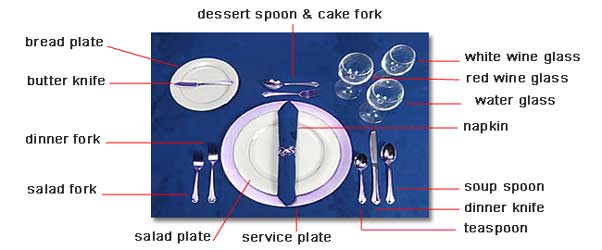
formal table setting

La cultura occidental utiliza el cuchillo, el tenedor y la cuchara, aunque hay dos formas de utilizarlos: el estilo norteamericano y el estilo europeo.

(Western culture uses knife, fork and spoon, although there are two styles to use them: The American style and the European style.)

American style

El estilo norteamericano (también llamado "método zigzag"): el cuchillo en la mano derecha, el tenedor en la mano izquierda, con los "dientes" siempre hacia abajo. Corta un bocado, coloca el cuchillo en el borde del plato, con el filo hacia dentro. Pasa el tenedor a la mano derecha y llévate la comida a la boca. La mano izquierda reposa sobre tu regazo –aunque esto es cada vez menos frecuente y dejas la mano izquierda sobre la mesa. Repite el proceso para cada bocado.

(American Style (or zigzag method): Knife in your right hand, fork in your left hand, tines down. Cut a bite-sized piece of food, then place the knife on the edge of the plate with blade facing in. Switch the fork to the right hand and bring the food to the mouth. Your left hand stays on your lap, although, today this is less and less common and you can leave it on the table. Repeat for each bite.)

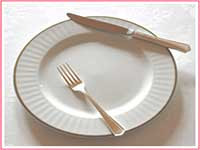
Una vez utilizados, los cubiertos no deben volver a tocar la mesa, ni siquiera el mango. Siempre déjalos en el borde del plato.

(Once used, utensils, including the handles, must not touch the table again. Always rest them on the side of the plate.)

El estilo europeo: no se cambian los cubiertos de mano –se come con el tenedor en la mano izquierda.

Continental style

(European Style: You don't switch hands –you eat with your fork in your left hand.)

Cuando se hace una pausa mientras se come, se indica que no se ha acabado también hay dos formas distintas de hacerlo:

(When you pause while eating, and you have not finished yet, there are also two ways of showing it:)

Not finished, AmericanNot finished, continental style

Cuando finalmente se ha acabado de cenar:

(When finally you are done with your dinner:)

I have finished, American styleI have finished, continental style

Fuente

CON PALILLOS

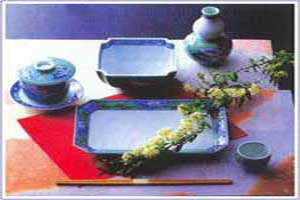
Chinese table settingJapanese table setting

Los palillos se utilizan en toda Asia Oriental (China, Corea y Japón), aunque se cree que nacieron en China durante la Dinastía Shang (1766 a.C. – 1122 a.C.), hace más de 3000 años. También se le atribuye a Confucio su extensa popularidad ya que éste equiparaba los cuchillos con actos de agresión lo que iba en contra de sus enseñanzas y por lo tanto no tenían cabida en la mesa.

(Chopsticks are used in the whole eastern Asia, including China, Korea and Japan although it is believed that they originated in China during the Shang Dynasty (1766 BC - 1122 BC), more than 3,000 years ago. Confucius equated knives to acts of aggression which went against his teachings and thus, did not allow them on his table.)

Tanto el protocolo chino como japonés comparten algunos tabúes al utilizar los palillos que tenemos que tener en cuenta:
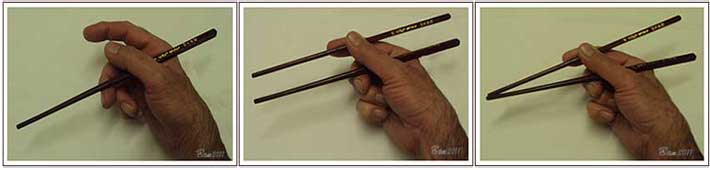
Chopstick holding

(Both Chinese and Japanese etiquettes share some taboos about using chopsticks that we may pay attention to:)

No apuntar nunca con los palillos

(Never point your chopsticks.)

No cruzar los palillos.

(Do not cross your chopsticks.)

No pinchar la comida con los palillos.

(Do not pierce your food with chopsticks.)

• Si queremos algo que está fuera de nuestro alcance y otra persona se ofrece para pasarlo, pásale tu plato. Pasar algo de palillos a palillos simboliza la muerte de un ser querido.

(If you want something that is out of reach and another person offers to pass it to you, give them your plate. The passing of an object from chopstick to chopstick has come to symbolize death of a loved one.)

• Vuelve los palillos y utiliza la parte ancha para coger algo de un plato de servir.

(Turn your chopsticks around and use the wider ends when taking something from a serving dish.)

CON LOS DEDOS

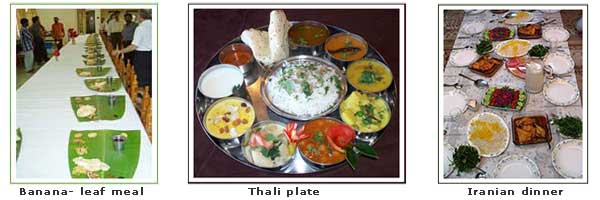
banana-leaf settings1 - 2 - 3

En la India, en partes del Sureste Asiático y en África, una gran mayoría de gente disfruta de la comida con todos los sentidos —la vista, el olfato, el gusto...y el tacto: comen con los dedos.

(In India, parts of Southeast Asia and in Africa, a great majority of people enjoy the process of eating with as many of the senses as possible –sight, smell, taste and... touch: they eat with their fingers.)

A pesar de que mucha gente puede verlo como una falta de higiene, lo que está claro es que al lavarse bien las manos antes de comer, podemos estar seguros de la limpieza del "cubierto" que nos llevamos a la boca.

(Although many people can see it as a lack of hygiene, what is clear is that as you wash thoroughly your hands before eating, you can be really sure about the cleanliness of the utensil you bring to your mouth.)

Por supuesto, aquí también existen convenciones y, la más importante es: sólo se utilizan tres dedos y el pulgar de la mano derecha –la izquierda sólo se utiliza para pasar platos si es necesario

(Obviously, there are also conventions of good manners when eating with your fingers. The most important is: only use three fingers and the thumb of your right hand –your left hand is for passing a dish, if necessary.)

eating with your fingers properly(Via)

Empieza a comer cogiendo comida con el pan. Corta un trozo pequeño de torta (con una sola mano, si sabes) y envuélvelo sobre un bocado de verduras o carne y llévatelo a la boca.

(Start eating by picking the food up with the bread. Tear off a small piece of flatbread (only with one hand) and place it over some of the vegetables or meat folding the bread over the top of the food and eat it.)

Mezcla un poco de arroz y curri en el plato con la punta de los dedos.

(Mix a bit of curry and rice together on the plate to make a little ball.)

Forma una pelotita con la punta de los dedos y la ayuda del pulgar.

(Make a small ball with your thumb and the tip of your fingers)

• Llévate el bocado a la boca y con el pulgar, suavemente impulsa la comida en la boca.

(Move the food to your mouth and use your thumb to gently catapult the food into your mouth.)

Bueno, ésto sólo es un vistazo superficial a unas costumbres bastante complejas; y ahora a practicar estas vacaciones, viajando. En cualquier caso, creo lo importante es que seamos educados y respetuosos, observemos a nuestros anfitriones y los imitemos.

(Well, this is just a quick look at rather complex customs and now we have to practise during our holiday travelling abroad . All in all, I think the most important thing is to be polite and respectful, to watch our hosts and follow their lead.)

Y, hablando de vacaciones, durante el mes de agosto este blog estará de vacaciones. Mientras tanto os deseo unas muy descansadas y felices vacaciones y espero veros a la vuelta el día 1 de septiembre. ¡Hasta la vuelta!

(Speaking of holidays, during August this blog will be on holiday too. Meanwhile, enjoy a very restful and happy holiday and I hope to see you around by September 1. See you then!)

Happy summer holiday

Fuentes: International Etiquette, Customs and Protocol Guide - Etiquette Scholar

lunes, 18 de julio de 2011

Los mismos colores, distintos significados

Color meanings

Color: sensación producida por los rayos luminosos que impresionan los órganos visuales y que depende de la longitud de onda. (RAE)

Colour (US color): the property possessed by an object of producing different sensations on the eye as a result of the way it reflects or emits light. (Oxford Dictionaries)

Aunque la luz y el color son los mismos para todos nosotros, lo que nos sugieren depende de nuestra cultura.

(Even though light and colours are the same all around the world, what they tell us depends on our culture.)

Red around the World

• Occidente —Europa y Norteamérica: peligro, amor, emoción, sacrificio, detenerse
• Oriente: alegría, color nupcial, celebración, buena suerte, felicidad, larga vida
• Aborígenes australianos: tierra
• África: muerte, vitalidad, riqueza
• Egipto: suerte
• Méjico: religión
• Nueva Zelanda: nobleza
• Sudáfrica (zulúes): luto
Personalidad: inteligente, enérgico y propenso a los cambios bruscos de humor.

(Western —Europe and North America: Danger, love, Excitement, sacrifice, stop
Eastern: Joy, bridal colour, celebration, good luck, happiness, long life
Australian Aboriginals: Land
Africa: Death, vitality, wealth
Egypt: Luck
Mexico: Religion
New Zealand: Nobility
South Africa (Zulus): Mourning
Personality: Bright, energetic and prone to mood swings)

Orange around the World

• Occidente: Halloween (con el color negro)
• Egypto: luto
• India: sagrado
• Japón: valentía, amor
Personalidad: sociable, cálido y optimista.

(Western: Halloween (with black)
Egypt: Mourning
India: Sacred
Japan: Courage, love
Personality: Social, warm and optimistic.)

Yellow around the World

• Occidente: esperanza, felicidad, cobardía, debilidad
• China: sagrado
• Egipto y Méjico: luto
• India: comercio
• Japón: valentía
• Sudáfrica (zulúes): riqueza
Personalidad: lleno de imaginación, impulsivo, con las ideas muy claras.

(Western: Hope, happiness, cowardice, weakness,
China: Sacred
Egypt and Mexico: Mourning
India: Commerce
Japan: Courage
South Africa (Zulus): Wealth
Personality: Imaginative, impulsive, very clear about your thoughts.)

Green around the World

• Occidente: primavera, Día de San Patricio, conciencia ecológica
• China: infidelidad, exorcismo
• Egipto: color nacional, santidad, fertilidad
• Japón: vida, alta tecnología
• India: islam
• Indonesia: color prohibido
• África del Norte: corrupción
• Sudáfrica (zulúes): naturaleza
Personalidad: práctico en la vida, leal, cariñoso y con fuerte voluntad

(Western: Spring, Saint Patrick's Day, environment awareness
China: Infidelity, exorcism
Egypt: National colour, holiness, fertility
Japan: Life, high-tech
India: Islam
Indonesia: Forbidden colour
North Africa: Corruption
South Africa (Zulus): Nature
Personality: Practical in life, loyal, affectionate and have a strong will.)

Blue around the World

• Estados Unidos: confianza
• China: inmortalidad
• Egipto: santidad
• India: color de Krishna
• Irán: paraíso, luto
• Japón: paraíso, espiritualidad
• Escandinavia: limpieza
• Sudáfrica (zulúes): felicidad
Personalidad: sensible, de confianza, seguro y prudente.

(United States: trust
China: Immortality
Egypt: Holiness
India: Krishna
Iran: Heaven, mourning
Japan: Heaven, spirituality
Scandinavia: Cleanliness
South Africa (Zulus): Happiness
Personality: Sensitive, trustworthy, confident and cautious.)

Purple around the World

• Occidente: realeza
• China: nobleza
• Egipto: virtud
• India: reencarnación
• Tailandia y Brasil: luto
Personalidad: creativo, compasivo y sensible

(Western: Royalty marriage
China: Nobility
Egypt: Virtue
India: Reincarnation
Thailand and Brazil: Mourning
Personality: Creative, compassionate and sensitive.)

Pink around the World

• Occidente: femenino
• Oriente: matrimonio
• Sudáfrica (zulúes): pobreza
Personalidad: generoso, reservado, romántico y sensible.

(Western: Feminine
Eastern: Marriage
South Africa (Zulus): Poverty
Personality: Generous, reserved, romantic and sensitive.)

White around the World

• Occidente: matrimonio, paz, pureza, santidad
• China y Japón: muerte, luto
• Egipto e Irán: posición, santidad
• Etiopía: enfermedad
• India: renacimiento
• Nigeria: buena suerte
• Nueva Guinea: prosperidad
• Sudáfrica (zulúes): bondad
Personalidad: muy organizado, lógico, práctico y optimista.

(Western: Marriage, peace, purity, holiness,
China and Japan: Death, mourning
Egypt and Iran: Status, holiness
Ethiopia: Illness
India: rebirth
New Guinea: Prosperity
Nigeria: Good luck
South Africa (Zulus): Goodness
Personality: Very organized, logical, practical and optimistic.)


Black around the World

• Occidente: luto, muerte, Halloween, rebelión
• Aborígenes australianos y zulúes: el color de las personas
• China: color para los niños pequeños, confianza
• Nueva Zelanda: color patriótico
• Tailandia: mala suerte, maléfico
Personalidad: confianza en sí mismo, fuerza, poder

(Western: Mourning, death, Halloween, rebellion
Australian Aboriginals and Zulus: Colour of the people
China: Colour for young boys, trust
New Zealand: Patriotic colour
Thailand: Bad luck, evil
Personality: self-confidence, strength, power)

Brown around the World

• Occidente: sano, sencillo, saludable
• Aborígenes australianos: Color de la tierra
• India: luto
Personalidad: fiable, alentador y seguro de sí mismo

(Western: Wholesome, earthy, healthy
Australian Aboriginals: Colour of the land
India: Mourning
Personality: reliable, supportive and confident.)


En la India—y en cualquier parte del mundo con una comunidad hindúcelebran la venida de la primavera con un festival de colores, Holi, arrojándose polvos de colores y agua coloreada.

(In India—in any country in the world with Indian communities—they celebrate the coming of spring with a festival of colours, Holi festival, throwing coloured powder and coloured water to each other.

The Atlantic hizo el reportaje del festival de este año con fotos impresionantes.

(The Atlantic has an illustrated report of this year's festival with awesome pictures.)

Fuentes:
Colour Meanings by culture
Psychological Effects of Color
Visual Color Symbolism Chart by Culture

martes, 28 de junio de 2011

Ascensores

lifts or elevators

image

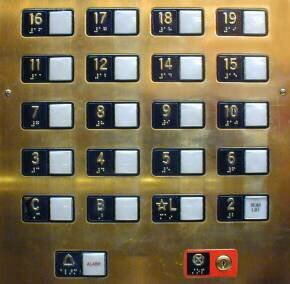
Cuando viajamos, son los detalles pequeños los que más nos despistan. Recuerdo cuando –hace siglos—tomé por primera vez un ascensor en Gran Bretaña y pulsé la B para bajar a la planta calle. Cuando se abrieron las puertas me quedé desorientado al encontrarme en el sótano ('basement'). Y es que se me había olvidado que para la planta calle hubiera tenido que pulsar la G ('ground floor' –planta baja).

(When we travel, sometimes little details make the difference. I remember when –ages ago—I took a lift for the first time in Great Britain and I pressed the B button to go to the ground floor (in Spain 'planta Baja'). When the doors opened, I was puzzled to be in the Basement. I had completely forgotten that to go to the ground floor I had to press the G button.)

European liftsBritish French Spanish

También debemos recordar que los norteamericanos llaman a la planta calle 'primer piso'. Y los franceses, Rez-de-Chaussée (RC/RDC), 'a ras de la calzada'.

(We must also remember that Americans call the ground-level floor of a building the 'first floor', and the French, 'rez-de-chaussée' (RC/RDC), 'level- with- the-street'.)

American elevatorAmerican lift
Chinese liftChinese lift

En algunos ascensores norteamericanos el piso que da acceso a la calle va señalado con una estrella de cinco puntas. Y, por supuesto, tanto en Estados Unidos como en Canadá, el piso número 13 suele "faltar".

(In some American lifts the button which indicates the ground-level floor has a five-pointed star. And, of course, both in the United States and Canada, the 13th floor is "missing".)

En los países asiáticos además del piso 13, omiten cualquier piso cuyo número lleve cuatro (es decir, 4, 14, 24, 34, 40-49,etc) por ser la pronunciación de este número muy similar a la de la palabra 'muerte'. Por lo que es fácil que estando en el piso 60 de un edificio, en realidad estés en el piso 44, el peor de todos.

(In Asia, apart from floor 13, any number with four is skipped (eg. 4, 14, 24, 34, 40-49, etc) because 'four' and 'death' sound alike. So you could be on a floor labeled 60, you are actually on the 44th floor, the worst ever.)

Así que, si viajáis al extranjero, prestad atención al botón que pulsáis si queréis llegar al piso que deseabais.

(So, when travelling abroad, pay attention to the button you press if you want to reach the floor intended.)

tallest buildings in the world

Y para acabar, algo increíble. Taipei 101 en Taiwan es el segundo edificio más alto del mundo, con 101 pisos y 509 metros de altura. Cuenta con 61 ascensores de los cuales dos son ultra-rápidos: recorren 1.010 metros por minuto, unos 16,83 metros por segundo. Ahora ya han sido superados por el ascensor del Burj Khalifa cuya velocidad asciende a 18 m/s.

(And now something amazing. Taipei 101 in Taiwan is the second tallest building in the world, with 101 storeys and 1,671 ft high. It has 61 lifts including two ultrahigh-speed lifts which travel 1,010 meters per minute, about 55.22 feet per second. They have now been overcome by Burj Khalifa's elevator in Dubai whose speed is 18 m /s.)

martes, 31 de mayo de 2011

Los taxis londinenses

London Black Cabs

Si decimos "taxi" y "Londres", ¿quién no imagina al instante este famoso icono inglés: el taxi negro?

(If we say "taxi" and "London", who does not instantly picture this famous English icon: the black cab?)

De hecho, son los únicos que pueden recoger pasajeros en las calles, ya que el otro tipo de "taxis", los 'mini taxis' deben ser alquilados previamente por teléfono o en una de sus oficinas.

(In fact, they are the only ones which can pick up passengers on the street, as the other type of "taxis", minicabs, must be booked in advance by phone or in any of their offices.)

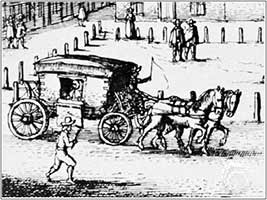
Hackney coach 1646(Hackney coach about 1646 - Engraving by W. Hollar. In Encyclopædia Britannica. )

En 1635, la Ley sobre coches de alquiler Hackney fue la primera legislación sobre taxis en Londres. Parece ser que el nombre 'Hackney' deriva de la raza de caballos, 'haquenée', que tiraban de los coches. En 1625 ya había unos 20 coches de alquiler. Hacia 1654 eran 300 con licencia en Londres y sus alrededores, y hacia 1832, unos 1.200. Hoy día, son unos 24.000 –en Zaragoza, mi ciudad, hay unos 1.800 taxis. El término 'coche Hackney' sigue siendo el término oficial para referirse a los taxis londinenses.

(In 1635, the Hackney Carriage Act was the first taxi cab legislation in London. It seems that the name 'Hackney' comes from the breed of the horse, 'haquenée', which drew carriages. In 1625 there were already about 20 hackney coaches plying for hire. By 1654 there were 300 licensed hackney coaches allowed in London and its environs, and by 1832 there were about 1,200. Today they are about 24,000 –in Zaragoza, my city, there are about 1,800 taxi cabs. 'Hackney carriage' is still the official term used to describe London taxis.)

Taxi cab 19th centuryFoto1930 taximeterFoto

Cuando se empezaron a utilizar los cabriolés, coches de dos ruedas franceses, a principios del siglo XIX, se empezaron a conocer como "cabs".
Y cuando Wilhem Bruhn inventa el taxímetro en 1891, nace el término de 'taxi'. Como su nombre indica (del francés taxe, 'precio', y del griego metron, 'medida'), el taxímetro mide la distancia recorrida y el tiempo transcurrido en el viaje, calculando la tarifa precisa que se ha de cobrar. Por cierto esta tarifa seguía siendo fijada por el Parlamento hasta el año 2000 cuando la Oficina de Transporte Para Londres empezó a controlar las leyes que rigen el negocio de los taxis londinenses.)

(When the drivers began using lighter cabriolets, two-wheeled vehicles from France, at the beginning of the 19th Century, they became known as 'cabs'. Likewise, when Wilhelm Bruhn invented the taximeter in 1891, the term 'taxi' was born. As its name says (from French taxe, 'price, and Greek metron, 'measure')the taximeter measures the distance travelled and time taken of all journeys, allowing an accurate fare to be charged. By the way, the fares were still set by Parliament as they have always been until 2000 when Transport For London took in charge the laws governing London's taxi trade.)

Todos los taxis londinenses tienen que aprobar las "Condiciones de Capacidad". Esto significa que tienen que tener un círculo de giro de 7,6 m (25 pies) —pueden dar la vuelta completa para salir de una fila central en ese espacio; el compartimento de los pasajeros tiene que ser lo suficientemente alto para que se pueda ir cómodamente sentado con un sombrero de copa en la cabeza y, la altura del nivel del suelo no puede ser superior a 38 cm (15 pulgadas). También deben ser accesibles para sillas de ruedas.

(All black taxis have to pass the 'Conditions of Fitness'. This means that they must have a 25 ft (7.6 m) turning circle so the cab can U-turn off a central rank, that the passenger compartment must be high enough that a top-hatted passenger can sit in comfort, and that the entrance must not be above 15 in (38 cm) from ground level. Cabs must also all be wheelchair accessible.)

Green Badge FotoLondon black cab

Hoy día, los aspirantes todavía tienen que superar estrictos exámenes antes de poder convertirse en taxistas en Londres. Deben ser mayores de 21 años y tener un minucioso conocimiento de la parte de Londres en la que quieren trabajar: a esto se le llama "El Conocimiento".

(Today, applicants still have to pass strict tests before they could become London taxi drivers. Drivers must be over 21 and have a thorough knowledge of London: this is 'The Knowledge'.)

"El Conocimiento de Londres" fue instituido en 1851 por Sir Richard Mayne, jefe de la policía metropolitana de Londres de 1829 a 1868, después de que algunos clientes se quejaran de que los taxistas no sabían adonde iban. Aprobar El Conocimiento supone recordar al detalle 320 rutas (o "carreras") con las 25.000 calles existentes dentro del radio de 6 millas (10 km) a partir de la estación de Charing Cross. Deben saber también el emplazamiento de clubes, hospitales, hoteles, estaciones, parques, teatros, restaurantes, escuelas y conservatorios, edificios gubernamentales y lugares de culto: cualquier punto conocido en el recorrido más corto de un punto a otro.

(The 'Knowledge of London' was introduced in 1851 by Sir Richard Mayne, head of the London metropolitan Police from 1829 to 1868, after some customers complained that cab drivers did not know where they were going. Passing the Knowledge involves detailed recall of 320 routes (or "runs") with the 25,000 streets within a six-mile radius of Charing Cross station. The locations of clubs, hospitals, hotels, railway stations, parks, theatres, restaurants, colleges, government buildings and places of worship are also required: any landmark along the shortest journey.)

Se puede tardar entre dos y cuatro años en aprobar el examen. De hecho, sólo tres de cada diez personas que empiezan el "Conocimiento" acaban y reciben la insignia verde que los acredita como conductores de un taxi londinense.

(It can take between two and four years to pass the test. In fact, only three out of ten people who begin the Knowledge finish and receive the green badge which entitles them to drive a London black cab.)

Aunque los taxis de Londres son tradicionalmente negros, hoy día a menudo exhiben coloridas publicidades en su carrocería.

(Although London's taxis are traditionally black, nowadays they often display colourful adverts on their bodywork.)

colourful London taxi cab 1Foto
colourful London taxi cab 3 Fotocolourful London taxi cab 4Foto

Así que la próxima vez que cojáis un taxi en Londres, disfrutad de estar en tan expertas manos y ser parte de tan antigua tradición.

(So the next time you take a taxi in London, enjoy being in such capable hands and taking part of such an ancient tradition.)

Fuentes: London Transport Museum, London Taxi Company

 
Arriba