lunes, 12 de octubre de 2009

Día del Pilar / Columbus Day

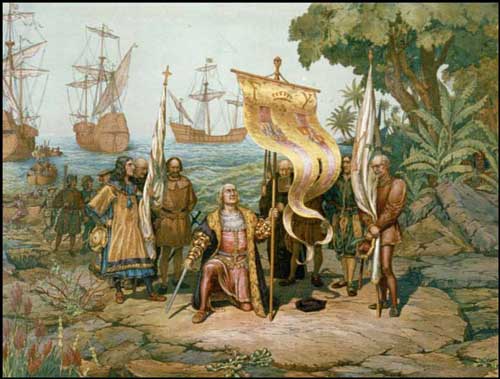
Our Lady of El PillarLanding of Columbus by John Vanderlyn (1837

El 3 de agosto de 1492, Cristóbal Colón emprendió su primer viaje a lo que vino a ser conocido como el Nuevo Mundo. Con tres naves y una tripulación de 90 hombres, Colón salió de Palos de la Frontera (Huelva) esperando encontrar una ruta occidental al Extremo Oriente. Por el contrario, la Niña, la Pinta y la Santa María llegaron a las Islas Bahamas.

Cristóbal Colón se hizo a la mar en una era de avances marítimos, trazando su ruta con la ayuda de una brújula (1), un astrolabio (2), un cuadrante (3), y una ballestina (4), también llamada Palo de Jacob, y basándose – según Bartolomé de las Casas, en el mapa (5) elaborado por Toscanelli.
(On August 3, 1492, Christopher Columbus set out on his first voyage to what came to be known as the New World. With three ships and a crew of ninety, Columbus set sail from Palos de la Frontera (Huelva) hoping to find a western route to the Far East. Instead, the Nina, the Pinta, and the Santa Maria landed in the Bahama Islands.
Christopher Columbus set sail in an era of maritime advances, charting his route with the aid of a mariner's compass, an astrolabe, a cross-staff (also called Jacob's staff), a quadrant and, according to Bartolomé de las Casas, Toscanelli's map.)

Columbus's travels

Columbus's travels

En la mañana del 12 de octubre de 1492, un miembro de la tripulación vio tierra. Al amanecer, Colón bajó a tierra y plantó la bandera del rey Fernando y la reina Isabel de España, en la isla de las Bahamas de Guanahaní. Colón finalmente creó una base de operaciones para su primer y segundo viaje en la isla que llamaron La Española, hoy República Dominicana y Haití. Los restos de Colón reposan en la Catedral de Sevilla.
(On the morning of October 12, 1492, a crew member spotted land. At daylight, Columbus went ashore and planted the flag of King Ferdinand and Queen Isabella of Spain, on the Bahamian island of Guanahaní. Columbus eventually created a base of operations for his first and second trips on the island they called Hispaniola, now the Dominican Republic and Haiti. Columbus' remains rest in the Cathedral of Seville.)

En Estados Unidos, el Día de Colón fue celebrado por primera vez el 12 de octubre de 1792. Un siglo después, se volvió a celebrar a petición del presidente Benjamin Harrison. Desde 1920 se celebra anualmente y, en 1971, se convirtió en una fiesta nacional que se celebra el segundo lunes de octubre.
(In the United States, Columbus Day was first celebrated on October 12, 1792. One hundred years later, it was celebrated again at the urging of President Benjamin Harrison. Since 1920, it has been celebrated annually and, in 1971, became a federal legal holiday to be celebrated on the second Monday in October.)

Esta celebración incluye desfiles por la Quinta Avenida de Nueva York así como en muchas ciudades. En años recientes, esta celebración ha sido criticada por gente que la ve como la celebración de una conquista y de un genocidio, por lo que prefieren celebrar el Día de los Pueblos Autóctonos.
(The celebration includes a parade down New York's Fifth Avenue and in a lot of smaller towns and cities. In recent years, the holiday has been rejected by people who view it as a celebration of conquest and genocide. In its place, Indigenous Peoples Day is celebrated.)

Muchas ciudades hispanoamericanas también celebran este día como el Día de la Raza, el Día de las Culturas en Costa Rica, el Día del Descubrimiento en las Bahamas, el Día de las Américas en Uruguay, el Día de la Resistencia Indígena en Venezuela.
(Many Latin American countries celebrate this day as Day of the Race, as Day of the Cultures in Costa Rica, as Discovery Day in The Bahamas, Day of the Americas in Uruguay and Day of Indigenous Resistance in Venezuela .)

En España, desde el 12 de octubre de 2000 también es el Día oficial de las Fuerzas Armadas, celebrado con un desfile militar en Madrid pero todo esto palidece ante la celebración del día de fiesta en honor a la Virgen del Pilar, en Zaragoza.
(In Spain since 2000, October 12 has also been Spain's Day of the Armed Forces, celebrated each year with a military parade in Madrid. But all this is overshadowed by the feast day of Our Lady of the Pillar in Zaragoza.)

Festivals of El Pilar

Zaragoza tiene una población de más de 600.000 habitantes, pero durante las Fiestas del Pilar llegan a ser más de 2 millones. Esta fiesta es nacional e internacionalmente conocida, ya que muchos de los visitantes vienen de fuera, desde Finlandia hasta Australia y es una costumbre que todo el mundo lleve puesto el cachirulo – pañuelo de cuadros rojos y negros para Zaragoza, azules y negros en Teruel y violeta y negro en Huesca .
(Zaragoza has over 600,000 inhabitants, but during Fiestas del Pilar it is increased to over 2 millions. The holiday is nationally and internationally known, since very many of the visitors come from abroad, from Finland to Australia and it is a custom that everyone in the festival wear a red checkered scarf for Zaragoza, light blue for Teruel and purple for Huesca).

gigantes

cabezudos

La fiesta dura una semana durante la cual la ciudad está muy animada con vaquillas por la mañana temprano, pasacalles, Gigantes y Cabezudos y por las noches la gente se reúne en el Paseo de la Independencia y muchas plazas para ver conciertos. Durante todo el día hay multitud de actos culturales.
(The holiday lasts for 7 days, during which the city is extremely lively with vaquillas (amateur bullfighting) early in the morning, passacaglia, Gigantes y Cabezudos (giant carnival figures with huge heads) and in the nights people gather to the main street of Zaragoza and many places to see concerts.During the rest of the day there are any number of cultural functions.)

Por lo que, ¡Felices Fiestas del Pilar!

viernes, 9 de octubre de 2009

Curioso

cat brushing teeth striped toothpaste

No sé si os pasará como a mí pero mientras me cepillaba los dientes me pregunté que por qué las rayas de la pasta de dientes no se mezclaban , así que me puse a buscar y aquí está la explicación.
(I do not know if you are like me but as I brushed my teeth, I wondered why the stripes on toothpaste did not muddle up, so I started looking up and here's the explanation.)

Los tubos de pasta se rellenan desde atrás y los sellan.
Los colores se conservan en compartimentos distintos en el tubo para que no se mezclen. El tubo tiene un sistema de boquilla que obliga los colores a salir al mismo tiempo que la pasta blanca. Boquillas diferentes permiten distintas rayas.
(Toothpaste tubes are filled from the end and then sealed. The different colours are placed in different compartments so as not to muddle up.The tube contains a nozzle system that forces the colored bits out of the tube at the same time as the white stuff. Different nozzle designs allow different toothpaste stripes to be made.)

toothpaste nozzle


staplerAl buscar la explicación tropecé con algo que me ha hecho ver mi grapadora de forma distinta. ¿Sabíais que se podía grapar de dos formas?
(Seeking this explanation I came across something that made me see my stapler differently. Did you know that there were two ways of stapling?)


stapledSi quieres grapar folios para conservarlos así, los grapas con las puntas de la grapa dobladas hacia dentro.
(If you want to keep your sheets stapled, you have to staple them with the end of the staple bent inwards.)


pinnedSi lo que quieres es simplemente mantenerlos juntos pero los vas a desgrapar más tarde, puedes graparlos con las puntas de la grapa hacia fuera y así será más fácil quitarla.
(If you just want to keep them together but separate them later, you can staple them with the ends of the staple out and so it will be easier to remove.)


¿Y cómo?

(How can you do that?)
stapler anvil


Muy sencillo. Si te fijas en el yunque de tu grapadora de mesa, éste puede girarse y así obtener el grapado que desees.
(Very simple. If you look at the stapler anvil, it can be rotated and thus obtain the desired stapling.)


Divertido, ¿verdad?
(Fun, isn't it?)

Casco stapler
También he descubierto que los españoles inventaron un tipo de grapadora –la grapadora "casco"– así que he pensado en indagar a ver si va a ser mentira eso de que aquí en España no inventamos. Ya os contaré.
(I also found out that the Spanish invented a type of stapler – the stapler 'Casco' – so I think I'm going to investigate a little to see if it isn't a lie that here in Spain we do not invent. I'll tell you.)


martes, 6 de octubre de 2009

The Smithsonian Institution

Smithsonian Institution on the Mall

El Instituto Smithsoniano en cifras:

Museos(Museums)19 (10 en the Mall)
Museos afiliados (Affiliate museums)156
Centros de Investigación (Research centres) 9
Empleados (Employees)6.300
Visitantes (2008) (Visitors)
Museos Smithsonianos (Smithsonian museums)25,2 millones
Zoo Nacional (National Zoo)3 millones
Exposiciones itinerantes (Travelling exhibitions)5,1 millones
Visitantes del sitio web (Website visitors)172,8 millones
Colecciones (Collections)más de 136 millones

El Instituto Smithsoniano fue fundado gracias al legado en beneficio de los Estados Unidos del científico británico James Smithson (1765-1829), quien nunca visitó los Estados Unidos en persona. En su testamento, James Smithson pidió que, de morir su sobrino Henry James Hungerford sin herederos, su patrimonio se convirtiera en propiedad de los Estados Unidos de América con tres condiciones:

1. que se llamara the Smithsonian Institution
2. que estuviera situado en Washington, D.C.
3. que sirviera para la creación de un "centro para la ampliación y difusión del conocimiento entre los hombres".

(The Smithsonian Institution was founded from a bequest to the United States by the British scientist James Smithson (1765–1829), who had never visited the United States himself. In his will, James Smithson stated that should his nephew, Henry James Hungerford, die without heirs, the Smithson estate would go to the government of the United States with three conditions:
1. that the entity be named the Smithsonian Institution
2. that it be located in Washington, D.C.
3. it serve "the increase and diffusion of Knowledge among men".)


Bueno creo que merece la pena visitar su página web Smithsonian y puedes perderte horas navegando por ella.

También, si quieres entretenerte un rato y todavía no la has visto, Noche en el museo 2: la batalla del Smithsoniano, para la que por primera vez la institución ha permitido a un equipo de rodaje entrar en sus instalaciones, con una condición: en horas de visitas.

(Well I think it is worth visiting their website and you can spend hours surfing it.
Also, if you feel like a little entertainment and still have not seen it,
Night at the Museum 2: The battle of the Smithsonian, for which the institution has allowed a film crew into their facilities for the first time, with one condition: in visiting hours.)

viernes, 2 de octubre de 2009

¡Río de Janeiro 2016!

Congratulations Rio

Río de Janeiro organizará los Juegos olímpicos de verano de 2016 tras ganar a Madrid por 66 votos a 32.

Chicago era considerada favorita junto con Río al entrar en la votación. Pero, a pesar de la participación del Presidente Obama en la presentación final y Michelle Obama promocionando su ciudad natal los tres últimos días, la ciudad sufrió una espectacular salida de la primera ronda.

Tokio salió en la segunda ronda, dejando a Madrid como el único contrincante en una oportunidad histórica para Río de convertirse en la primera ciudad de Sudamérica en organizar unos Juegos.

La victoria de Río de Janeiro deja a África y la Antártida como los únicos continentes que nunca han acogido unos Juegos Olímpicos.

¡Enhorabuena Río! Parabéns Rio!

(Rio de Janeiro will host the 2016 Summer Olympic Games after beating Madrid, 66 votes to 32.
Chicago was considered a frontrunner along with Rio coming into the vote. But, despite President Obama's participation in the final presentation and Michelle Obama lobbying the last three days for her hometown, the city suffered a stunning first-round exit.
Tokyo went out in the second round, leaving Madrid as the only contender to Rio's historic opportunity of becoming the first city in South America to host the Games.
Rio's victory leaves Africa and Antarctica as the only continents that have never hosted an Olympics.
Congratulations Rio!)

jueves, 1 de octubre de 2009

¿Madrid 2016?

applicant cities for 2016 Olympic Games

Desbordado por una semana repleta aunque quizá no tanto como la de los encargados de dar los últimos toques a la candidatura de Madrid para albergar los Juegos Olímpicos y Paralímpicos en el verano de 2016.

Mañana viernes, a las 19'00 aproximadamente se sabrá cuál de estas cuatro ciudades ha sido la elegida en Copenhague, donde se reúne el COI (Comité Olímpico Internacional).

Hasta que lo sepamos os dejo este video que hizo una estudiante de la universidad de Chicago para un trabajo de clase en mayo de 2008 sobre la candidatura de Madrid.

(Busy week, though perhaps not so busy as the week of the people in charge of putting the finishing touches to the Madrid bid to host the Olympic Games and Paralympic Games in summer 2016.
Tomorrow Friday, at about 19'00 we will know which of these four cities is the chosen one.
Until then I leave you this video by a Chicago university undergrad as part of a class project in May 2008 on the Madrid bid. )

Olympic Flag

Y, por cierto, ¿qué representan los anillos olímpicos?

Según el COI, la universalidad de los Juegos, basados en la idea de que al menos uno de los seis colores de la bandera olímpica está en todas las banderas de los países del mundo.

El símbolo se remonta a 1913 cuando Pierre de Coubertin (creador de los Juegos), en la Revue Olympique de agosto, informó del símbolo que sería usado para el Congreso Olímpico de París, en 1914: "cinco anillos entrelazados de diferentes colores (azul, amarillo, negro, verde y rojo), sobre el campo blanco del papel. Estos cinco anillos representan las cinco partes del mundo (las Américas, Europa, Asia, África y Oceanía) que se han unido al Olimpismo y que han aceptado competir sanamente."

(And, by the way, what do the Olympic rings represent?
According to the IOC, the universality of the Games, based on the idea that at least one of the six colours of the Olympic flag are in all the flags of the countries in the world.
The symbol dates back to 1913 when Pierre de Coubertin, in the
Revue Olympique announced that the symbol that would be used for the Olympic World Congress in Paris in 1914 was: five intertwined rings in different colours (blue, yellow, black, green and red) on the white field of the paper. These five rings represent the five parts of the world (the Americas, Europe, Asia, Africa and Oceania) that have joined the Olympic Movement and that have agreed to compete healthily.")

Además, los seis colores combinados representan a todas las naciones sin excepción. El azul y el amarillo de Suecia; el azul y el blanco de Grecia; los tricolores mexicanos, franceses, británicos, estadounidenses, alemanes, belgas, italianos y húngaros; el amarillo y el rojo de España yacen junto a las banderas brasileñas y australianas y a las de Japón y China. Éste es, realmente, un emblema internacional.

(In addition, the six colours combined represent all nations without exception. The blue and yellow of Sweden, the blue and white of Greece, the tricolour Mexican, French, British, American, German, Belgian, Italian and Hungarian, the yellow and red of Spain lie next to the Brazilian and Australian flags and of Japan and China. This is really an international emblem.)

Bueno, la suerte está echada, así que ¡suerte a todos!
(Well, the die is cast, so the best of luck to all!)

 
Arriba