
¿Qué hay detrás de los nombres de Harry Potter y sus amigos? ¿Por qué los eligió J.K. Rowling?
(What's behind the names of Harry Potter and his friends? Why did J.K. Rowling choose them?)
"Colecciono nombres poco corrientes. Tengo libretas llenas de ellos. Algunos nombres los invento, como Quiddish o Malfoy. Otros nombres tienen un significado. Y tengo nombres de santos, lugares, monumentos a los caídos, lápidas. Sólo los colecciono – me interesan tanto los nombres."

Henry James Potter (July 31, 1980)
El nombre de Potter, además de "alfarero" o "ceramista", también significa "fosa común ", un cementerio en el que solían enterrar a personas desconocidas o muy pobres.
"Harry" es el nombre preferido por Rowling para un chico. El nombre es de origen anglosajón y significa "poder".
Y "James", por ser el nombre de su padre.
(Potter's name, apart the person who makes ceramic wares, refers to a "potter's field," which is a cemetery in which people of unknown identity or the very poor are buried. "Harry" is Rowling's favorite boy's name. It is of Anglo-Saxon origin and means "power." "James" after his father.)
El cumpleaños de Harry "coincide" con el cumpleaños de Rowling (ella en 1966) y, casi con el cumpleaños de Daniel Radcliffe, el actor que lo encarna en las películas, que nació el 23 de julio de l989.
(Harry's birthday "coincide" with Rowling's birthday also on July 31—but in 1966, and almost Daniel Radcliffe's birthday which is on July 23, 1989.)

Varita mágica: de madera de acebo, mide 28 cm y su alma es de plumas de fénix; las plumas son de la cola de Fawkes, el fénix de Dumbledore. Esta varita es "hermana" de la de Voldemort.)
(Harry Potter's wand is made of holly, measures 11'' long, and has phoenix feathers embedded in its core; feathers are from Fawkes's tail, Dumbledore's phoenix. This wand is "brother" to Voldemort's wand.)

"Hedwig" es el santo patrón de los huérfanos y vivió en Alemania en los siglos XIII y XIV.
Su nombre significa "refugio en la batalla."
(The Saint of Orphans that lived in Germany in the 13th and 14th Century. Means "refuge in battle.")
Las lechuzas son el principal medio de comunicación entre magos en el mundo de Harry. Sin embargo, en muchas partes del mundo, se pensaba que las lechuzas traían mala suerte y eran anunciadoras de muerte.
(Owls are the primary means of communication between wizards in Harry's world. However, in many parts of the world, owls are considered bad luck and harbingers of death.)
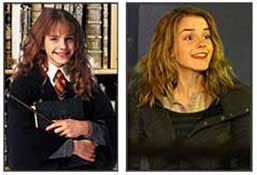
Hermione Jean/Jane Granger (September 19th, 1979)
"Granger" significa "granjero", una persona muy común, al igual que los padres de Hermione.
"Hermione" significa "bien nacido", "sencillo" o "piedra". El nombre procede de la obra "El cuento de invierno" de William Shakespeare.
(Granger - A granger is a very common person, just like Hermione's parents. Hermione - Means "well-born," "earthy," or "stone." The name is derived from William Shakespeare's The Winter's Tale; Rowling claimed that she wanted it to be unusual since if fewer girls shared her name, fewer girls would get teased for it.)

La varita de Hermione Granger es de madera de vid, mide 27 cm de largo y su alma es de corazón de dragón.
(Hermione Granger's wand is made of vine wood, measures 10¾" long and has Dragon heartstring in its core.)

Ronald Bilius Weasley (March 1, 1980)
"Ron", Ronald del nórdico antiguo "Rögnvaldr": "Tener el poder de los Dioses"
"Bilius", bilioso, uno de los cuatro "humores" (temperamentos) según Hipócrates, denota enojo y mal humor.
(J.K. Rowling said: "In Britain and Ireland the weasel has a bad reputation as an unfortunate, even malevolent, animal. However, since childhood I have had a great fondness for the family mustelidae; not so much malignant as maligned, in my opinion." The Weasleys and the weasel both share red hair. "Ron" (from old Norse, Rögnvaldr, "Having the Gods' Power". "Bilius", bilious, one of the four "humors" (temperaments) according to Hippocrates, indicating anger and peevishness.)

La varita mágica de Ron está hecha de madera de fresno, mide 30 cm y tiene alma de crin de unicornio.
(Ron Weasley's wand is made of ash wood, measures 12" long and unicorn hair embedded in its core.)

Albus Percival Wulfric Brian Dumbledore (July? August? 1881 - June, 1997)
"Dumbledore" es una palabra en Inglés Antiguo que significa "abejorro".
En cuanto a los nombres se puede interpretar que representan las cuatro primeras divisiones de las islas británicas: "Albus" en latín significa "blanco" pero también es la forma masculina de "Alba" antiguo nombre de Escocia; "Percival" fue un caballero galés de la Tabla Redonda del Rey Arturo que participó en la búsqueda del Santo Grial; "Wulfric" es un nombre anglosajón y puede que represente a Inglaterra; finalmente, "Brian" es un nombre celta, que significa "fuerte".
("Dumbledore" is an Old English word meaning "bumblebee". As Rowling stated "it seemed to suit the headmaster, because one of his passions is music and I imagined him walking around humming to himself". Dumbledore's given names could be interpreted as representing the four primary divisions of the British Isles: "Albus" is Latin for "white but also the masculine form of "Alba", an ancient name for Scotland; "Percival" was a Welsh knight of King Arthur's Round Table involved in the Grail quest; "Wulfric" is an Anglo-Saxon name and could be representative of England; finally, "Brian" is a Celtic name, meaning "strong.")

La varita de Dumbledore está hecha de madera de saúco, mide 38 cm y su alma es de crin de thestral.
(Dumbledore' s wand is made of elder wood, measures 15" long; its core: thestral hair.)

Rubeus Hagrid (December 6, 1928)
"Hagrid" más probablemente proviene del término "demacrado", que también significa "salvaje" o "rebelde".
"Rubeus" en latín significa algo producido a partir de una zarza o un matorral, lo que se ajusta a la descripción que Rowling hace de él como "salvaje".
("Hagrid" most likely comes from the term "haggard" which also means "wild" or "unruly". "Rubeus" is Latin for something produced from a bramble or a thicket, which fits Rowling's description of him as "wild.")

Draco Lucius Malfoy (June 5, 1980)
"Draco" en latín significa "dragón" y es una constelación que se parece a un dragón, pero es una serpiente. También hubo un legislador griego llamado Dracón que desarrolló un sistema de duros castigos para los más insignificantes de los delitos. De ahí que el adjetivo "draconiano" signifique "duro o cruel".
("Draco" in Latin means "dragon".It is also a constellation that looks like a dragon but is a snake. There was also a Greek ruler named Draco who developed a system of severe punishments for the smallest of crimes. Hence the adjective "draconian" means "harsh or cruel.")
"Lucius" es un nombre que deriva del latín y significa "brillante" o "inteligente" y se relaciona con el nombre de Lucifer, el primer nombre de Satanás.
("Lucius" is a name that derives from Latin meaning "bright" or "intelligent" and is related to the name Lucifer, the first name of Satan.)
"Malfoy", en francés antiguo significa "mala fe".
(Malfoy is from the Old French and means "bad faith.")

La varita mágica de Draco Malfoy es de madera de espino, mide 25 cm y su alma es de crin de unicornio.
(Draco Malfoy's wand made of hawthorn, measures10" long and Unicorn hair embedded in its core. )

Severus Snape
"Snape": además del nombre de un pueblo del norte de inglaterra, significa "reprender", "herir", y "reproche" en inglés dialéctico anticuado de la zona.
"Severus" en latín significa "severo" o "duro". Parece ser que Rowling hizo el profesor de Pociones pensando en un profesor de Química que tuvo y que no le gustaba.
("Snape" apart from the name of a town in northern England, means "to rebuke", "to hurt" and "blame" in the obsolete dialectical English of the area. "Severus" is Latin for "stern" or "harsh." It seems that Rowling made the Potions professor considering a chemistry teacher that she once had and did not like.)

VOLDEMORT / TOM MARVOLO RIDDLE (December 31, c. 1926 — May 2, 1998)
El nombre de Voldemort viene de la expresión francesa que significa "vuelo/huída desde la muerte" o también "robar de la muerte". En la segunda novela (Harry Potter y la cámara secreta), Rowling nos muestra que "Soy Lord Voldemort" es el anagrama de "Tom Sorvolo Ryddle" (en la excelente traducción española de Adolfo Muñoz y Nieves Martín Azofra.)
(The name Voldemort comes from the French words meaning "flight from death," or "steal from death" and his entire goal is to conquer death. In the second novel (Harry Potter and the Chamber of Secrets), Rowling shows us that "I am Lord Voldemort" is an anagram of "Tom Marvolo Riddle," which is his actual full name. – The Spanish translators, Adolfo Muñoz and Nieves Martín Azofra, did an excellent work adapting the anagram.)

La varita mágica de Voldemort es de madera de tejo, mide 32 cm y su alma es de pluma de fénix. Es la "hermana" de la varita de Harry.
(Voldemort's wand is made of yew, measures 13½" long and has Phoenix feather in its core. "Brother" to Harry's wand.)
Lo cierto es que esto sólo es una pequeña muestra del rico y fascinante mundo creado por Rowling. Mundo al que os animo que os acerquéis si no lo habéis hecho todavía: primero los libros y después las películas.
No sé quién decía que envidiaba a los que empezaban a leer por tener ante ellos tantos mundos maravillosos por descubrir y recorrer.
A mí me pasa lo mismo.
(The truth is that this is only a sample of the rich and fascinating world created by J.K. Rowling. A World which I encourage you to know if you still have not done so, first with the books and then with the movies.
I do not remember who said that he/she envied those who were beginning to read because they had so many wonderful worlds to discover and explore. I feel the same.)
 |  |
Fuentes:
- Sitio oficial de J.K.Rowling
- Random History.com
- Mugglenet
- Harry Potter Wiki
- Accio Quote! (Largest archive of J.K. Rowling quotes on the web)
- El Diccionario.org (La enciclopedia del mundo de Harry Potter en Español)


 Según dicen en su página oficial, se entrará por el pueblo de Hogsmeade y podremos recorrer lugares de sobra conocidos por los que hemos leído los libros y visto las películas.


1. "Sushi" NO significa "pescado crudo".("Sushi" does not mean raw fish.)
La palabra japonesa para referirse al pescado crudo es "sahimi". La palabra "sushi", en realidad, proviene del tipo de arroz utilizado, "sumeshi", aderezado con vinagre, sal y azúcar. Los acompañamientos para el arroz pueden incluir tradicionalmente pescado crudo—pero también mariscos cocidos, huevas, huevos o verduras como el pepino, rábano chino o ciruela china.
(The usual Japanese term for raw fish is 'sashimi'. The term 'sushi' actually comes from the rice used, "sumeshi", which is gently folded with a vinegar and salt and sugar dressing. Toppings for the rice may traditionally include raw fish—but also cooked seafood, fish roe, egg, or vegetables such as cucumber, daikon radish, or ume plum.)
2. El azúcar NO provoca hiperactividad en los niños.
 La Academia Nacional de Ciencias y la Asociación Norteamericana de Dietética no han encontrado ninguna prueba definitiva que demuestre una relación de causa-efecto entre el consumo de azúcares y la hiperactividad. Los factores que influyen en el comportamiento de los niños son psicológicos.
(Sugar does not cause hyperactivity in children.)
(The National Academy of Sciences and the American Dietetic Association failed to find substantive evidence to prove a cause and effect relationship between sugar consumption and hyperactivity. The factors that influence children's behavior are psychological.)
3. Einstein NO tenía malas notas en el colegio.
(Einstein did not get bad grades in school.)
(Move the pointer over this picture to see it translated)
De hecho, era muy buen estudiante, sobre todo en ciencias y en matemáticas (como no podía ser de otra manera).
Una copia de las notas obtenidas en su examen final de secundaria, que aprobó el 3 de octubre de 1896 –a los 17 años—en Aarau (Suiza), muestra que Albert Einstein (1879-1955) era bueno en matemáticas en el instituto. Hay que resaltar que el 6 es la nota máxima que se obtenía en esa época.
(In fact, he did very well at school, especially in science and maths (unsurprisingly).A copy of Albert Einstein's matura, received on October 3, 1896 -at 17- in Aarau, shows that Albert Einstein was good at math in high school; note that 6 is the best possible mark at that time.)
4. Napoleón NO era bajito.

(Napoleon was not short.)
Existen varias teorías para explicar el apodo de "Le Petit Caporal" ("El pequeño Cabo"), pero pocos estudiosos modernos creen que se refiriera a su estatura física.
Después de su muerte en 1821, la altura del emperador francés fue registrada como de 5 pies 2 pulgadas en medida francesa. Esto corresponde a 5 pies 6,5 pulgadas según la medida actual, o sea 1,685 m, dentro de la media de altura de finales del siglo XVIII.
(There are competing explanations for why he was nicknamed le Petit Caporal (The Little Corporal), but few modern scholars believe it referred to his physical stature. After his death in 1821, the French emperor's height was recorded as 5 feet 2 inches in French feet. This corresponds to 5 feet 6.5 inches in modern international feet, or 1.686 metres, completely average for the late18th century. )
5. Thomas Edison NO inventó la bombilla incandescente.
 Thomas Alva Edison inventó muchas cosas –de hecho es uno de los inventores más famosos de todos los tiempos—pero la bombilla incandescente no fue uno de ellos. Fue Humphry Davy quien, en 1809, colocó una fina tira de carbono entre los dos polos de una pila, creando un fugaz arco luminoso, la base esencial en la que se basa el funcionamiento de una bombilla.
(Thomas Edison did not invent the light bulb.)
Lo que hizo Edison fue perfeccionar el invento. En 1879 inventó un filamento de carbono que permanecía incandescente durante 40 horas y lo colocó en una bombilla al vacío, creando la bombilla incandescente moderna que mejoró hasta que durara unas 1200 horas.
(Edison invented a lot of things – in fact he's one of the most famous inventors of all time – but the light bulb wasn't one of them. It was Humphry Davywho, in 1809, placed a thin strip of carbon between the two poles of a battery, creating a brief luminous arc, the essential base which underpins the operation of a light bulb. What Edison did was to improve the invention. In 1879 he invented a carbon filament that burned for forty hours and it placed it in an oxygenless bulb, inventing thus the modern light bulb which he improved until it lasted 1200 hours.)
Pero, lo que SÍ es cierto es que Andrea, una alumna, estuvo este verano en The Wizarding World of Harry Potter (del que ya os hablé), y me ha dejado unas fotos para que las compartamos con ella. ¡Gracias!
(But, what is certain is that Andrea, a student of mine, went to The Wizarding World of Harry Potter last summer, and she has left me some pictures so that we can share them with her. Thanks a lot.)
¡Feliz fin de semana!(Have a nice weekend!)